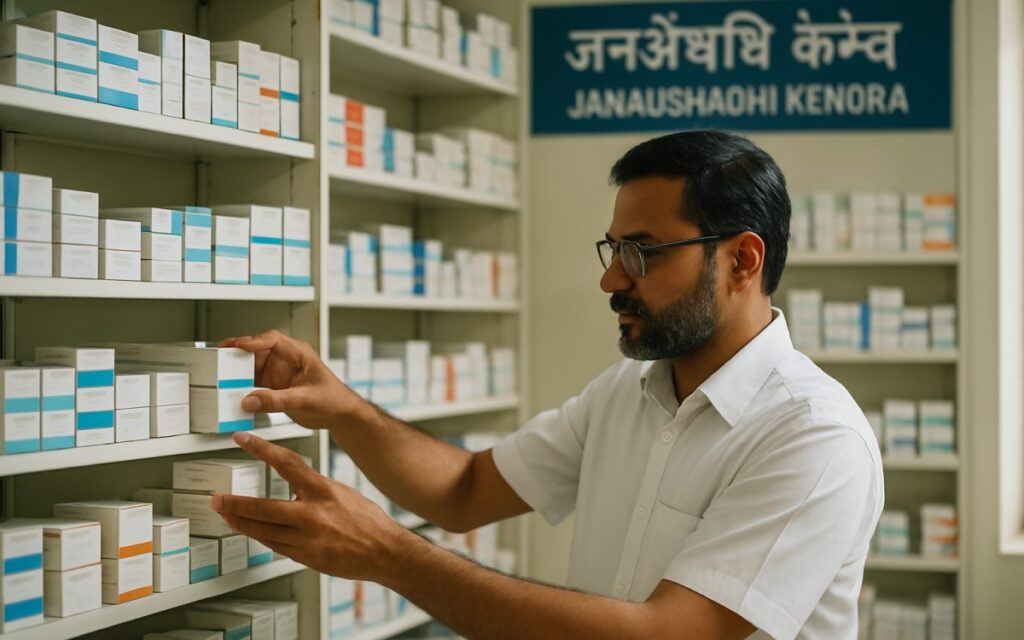
Pradhan Mantri Bhartiya Janaushadhi Pariyojana (PMBJP) is a central government scheme that aims to make quality generic medicines available to you at affordable prices through special pharmacy outlets called Janaushadhi Kendras. By focusing on low-cost generics that are equivalent in quality to branded drugs, the scheme seeks to reduce your out-of-pocket spending on healthcare. If you or your family regularly need medicines on prescription, PMBJP can significantly ease the burden on your monthly budget.
What Is Pradhan Mantri Bhartiya Janaushadhi Pariyojana?
PMBJP is a public welfare initiative of the Ministry of Chemicals and Fertilizers that promotes generic medicines instead of costlier branded versions. It was first launched in 2008 as the Jan Aushadhi Scheme and later revamped and renamed Pradhan Mantri Bhartiya Janaushadhi Pariyojana in 2015–2016 to increase its reach.
Under this scheme, authorised outlets called Pradhan Mantri Bhartiya Janaushadhi Kendras sell generic medicines that are approved as safe, effective and quality-assured. These medicines are typically 50 to 90 per cent cheaper than many branded alternatives, making long-term treatment more sustainable for you.
Key Objectives of the Scheme
The scheme has three broad objectives that directly affect you as a medicine buyer. Understanding these helps you see why it is being expanded across the country.
- To provide quality generic medicines at affordable prices so that you pay less for necessary treatment without compromising on safety or efficacy.
- To create awareness that generic medicines are therapeutically equivalent to branded drugs when approved by regulators, and can be used confidently on a doctor’s prescription.
- To generate self-employment opportunities by encouraging pharmacists, doctors, NGOs and other eligible groups to open and run Janaushadhi Kendras.
How PMBJP Works Behind the Scenes
You see the Janaushadhi Kendra at the front end, but there is a full supply chain working in the background. The implementing agency is the Pharmaceuticals & Medical Devices Bureau of India (PMBI), which operates under the Department of Pharmaceuticals.
PMBI procures generic medicines and medical products in bulk from approved manufacturers that meet specified quality standards. These products are then stored in central and regional warehouses and supplied to Janaushadhi Kendras across the country, helping maintain consistent availability for you.
Each medicine under the scheme is sold under a common PMBJP label with clear details such as generic name, strength and maximum retail price printed on the pack. This transparency lets you easily compare prices and understand what your pharmacist is dispensing.
Janaushadhi Kendras – The Frontline Outlets
Janaushadhi Kendras are dedicated pharmacy outlets where you can walk in and buy generic medicines at reduced prices. These outlets are usually located in hospital premises, busy markets, district headquarters, smaller towns and even remote areas, so that you can access them without much difficulty.
As of 2025, there are well over 16,000 functioning Kendras, and the government has announced a target to scale this up to around 25,000 outlets by 2027. Many of these stores are operated by individual pharmacists, self-help groups, NGOs and women entrepreneurs, who receive financial and logistical support to run the outlets.
Inside a typical Kendra, you will find medicines neatly arranged by category, including medicines for chronic diseases, common infections and everyday health needs. Trained pharmacists are expected to guide you on the correct medicine based on the prescription given by your doctor.
Types of Medicines and Products Available
The product basket under PMBJP is much wider than many people expect. It includes medicines as well as a range of surgical items and health products.
- Over 2,000 generic medicines covering major therapeutic areas such as antibiotics, anti-diabetics, cardiac drugs, pain relief, gastrointestinal medicines, vitamins and more.
- Around 300 types of surgical and medical consumables including syringes, gloves and other basic items.
- Certain hygiene products and nutraceuticals, including low-cost sanitary napkins such as the Suvidha sanitary pad, which has received attention for its very low unit price.
For you, this means that a large proportion of commonly prescribed medicines is likely to be available at a Janaushadhi Kendra in generic form. However, highly specialised or very new patented drugs may not always be part of the PMBJP basket.
Price Advantage and Savings for You
One of the biggest reasons to consider using Janaushadhi Kendras is the price difference. Multiple assessments have shown that medicines sold here are typically 50 to 80 per cent cheaper than many branded equivalents, and in some cases the reduction can be as high as 90 per cent.
For example, if a particular chronic disease medicine costs you ₹1,000 per month in a popular branded version, the equivalent generic under PMBJP might cost in the range of ₹200 to ₹500, depending on the drug. Over a year, this can translate into substantial savings, particularly for families where several members are on long-term treatment.
Government statements have indicated that the scheme has already led to cumulative savings of tens of thousands of crores for the public over the years. Those savings ultimately reflect smaller monthly bills for people like you, especially when you must buy medicines regularly.
Quality, Safety, and Role of Doctors
A common doubt you may have is whether lower prices mean lower quality. Under PMBJP, the medicines supplied are required to meet the same quality and safety standards as other approved drugs in the market.
Manufacturers supplying to PMBI must comply with Good Manufacturing Practices and other regulatory norms laid down by the national drug regulator. Batches are subject to quality testing at accredited laboratories to ensure they match required specifications for strength, purity and stability.
That said, you should not treat PMBJP as a substitute for professional medical advice. You should always use medicines under the guidance of a registered medical practitioner and ensure that the generic you receive matches the active ingredient and strength prescribed on your prescription.
How You Can Use a Janaushadhi Kendra
If you wish to start using PMBJP medicines, the process is quite straightforward. You can search online for the nearest Janaushadhi Kendra or ask at local hospitals and clinics, as many have one on or near the premises.
When your doctor issues a prescription, you can request that it be written using generic names instead of specific branded products. At the Kendra, show the prescription to the pharmacist, who will provide the corresponding generic medicines available under the scheme.
You should always check the name and strength on the strip or bottle and clarify any doubts about dosage or timing with the pharmacist. If a particular drug is unavailable, you can ask when the next stock is expected or whether an equivalent formulation is offered under PMBJP, and then confirm with your doctor where necessary.
Opening a Janaushadhi Kendra
If you are a pharmacist, doctor or part of an organisation looking for a social-impact business opportunity, you may consider opening a Janaushadhi Kendra. The scheme allows individuals, NGOs, self-help groups, cooperatives and similar entities to apply, subject to eligibility and documentation.
Typically, you need a valid retail drug licence, a qualified pharmacist, and suitable shop space that meets the norms. The scheme offers financial assistance such as a one-time support amount for setting up the store, along with a specified margin on sales and additional incentives for outlets in remote or underserved areas.
By running a Kendra, you can create local employment and contribute to lowering healthcare costs in your community while building a sustainable venture. Many new outlets in recent years have been opened by women entrepreneurs and self-help groups, supported by these incentives.
Why PMBJP Matters To You
If you or your family depend on long-term medication for conditions such as diabetes, hypertension, heart disease, asthma or thyroid disorders, PMBJP can help you manage costs more comfortably. Even for short-term treatments like infections, pain management or seasonal illnesses, using Janaushadhi Kendras can keep your expenses in check.
With plans to expand the network to tens of thousands of outlets by 2027, the scheme aims to bring affordable, quality-assured generics closer to your doorstep. By staying informed, talking to your doctor about generic options and using your prescription wisely at a Janaushadhi Kendra, you can make better decisions for both your health and your wallet.